
Cameroon Charts Stronger Response to Human Trafficking at National Consultation
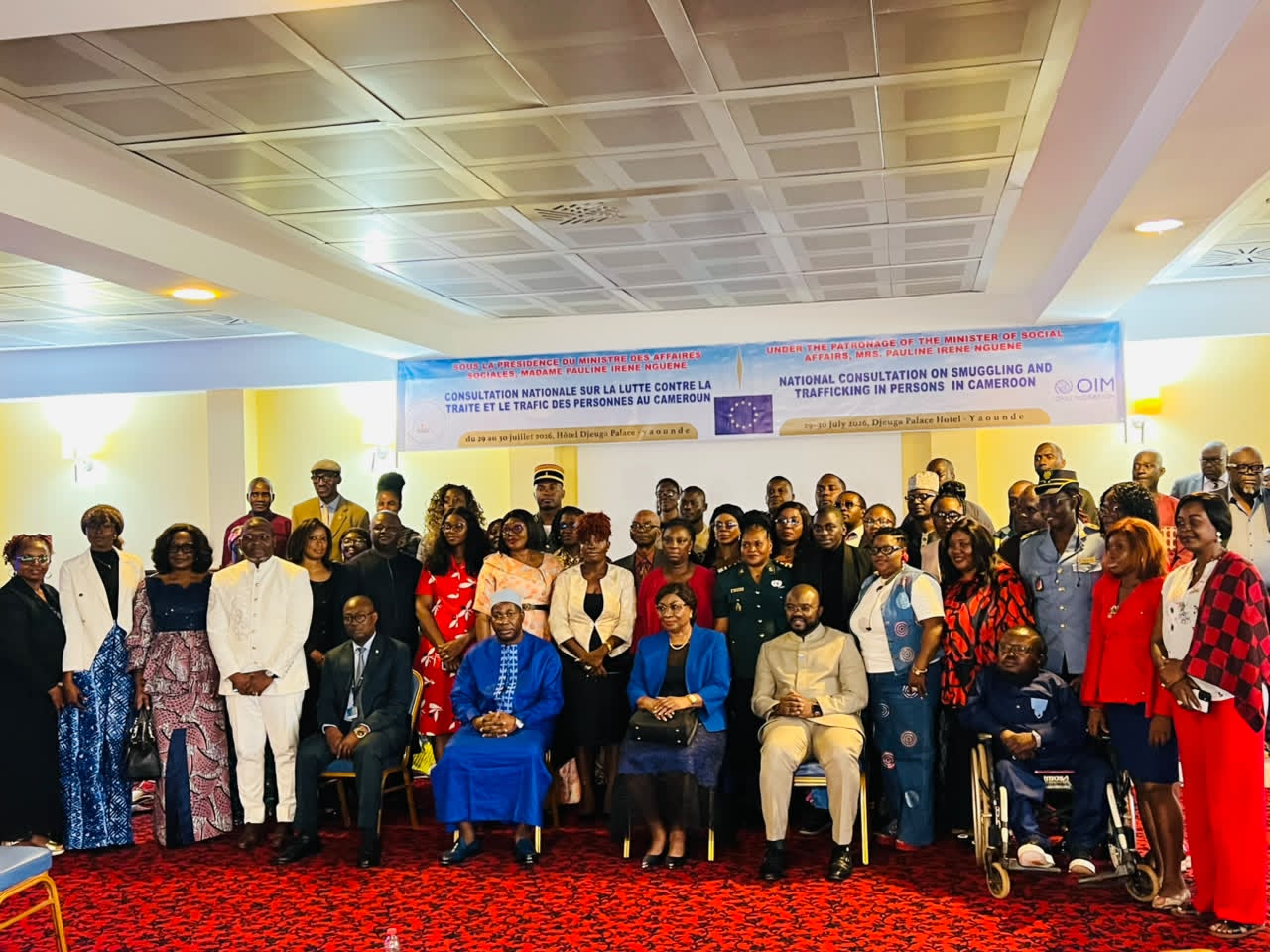
For two days, government officials, United Nations agencies, civil society organisations, development partners and survivors of human trafficking gathered in Yaoundé to examine one of the most pressing migration challenges facing Cameroon: trafficking in persons and the smuggling of migrants. Organised by the Platform for Dialogue and Exchange between the Government and Civil Society, in […]
Organised by the Platform for Dialogue and Exchange between the Government and Civil Society, in partnership with the International Organization for Migration (IOM), the national consultation ended with a series of recommendations expected to shape Cameroon’s first National Migration Policy.
The discussions highlighted persistent challenges, including weak institutional coordination, inadequate data collection and sharing, limited resources for victim assistance, evolving criminal networks and the growing use of digital platforms by traffickers.
Survivor’s testimony puts a human face on trafficking
One of the most emotional moments of the consultation came when survivor Rose Kanjo recounted her experience after being trafficked to Kuwait in 2015.
Promised a teaching job by a relative, she instead found herself trapped in domestic servitude.
“I worked 19 to 20 hours every day. I slept on the floor, ate leftovers, had no access to a phone and endured physical, emotional and sexual abuse,” she told participants.
Although her family eventually paid a ransom of 4,000 US dollars, Kanjo said she still had to devise a way to recover her passport and escape from her employer before returning to Cameroon.
Her testimony served as a stark reminder of the realities behind fraudulent overseas recruitment schemes and reinforced calls for stronger prevention and protection measures.
A roadmap for stronger action
Participants agreed that trafficking in persons and migrant smuggling should become a priority pillar of Cameroon’s future National Migration Policy.
Recommendations adopted during the consultation include strengthening national coordination mechanisms, reviewing the legal framework to better align with international standards, improving the collection and sharing of migration data, increasing sustainable funding for anti-trafficking programmes and establishing a harmonised national referral system for victims.
Delegates also called for nationwide awareness campaigns, particularly in vulnerable communities and border areas, while recommending the integration of migration and anti-trafficking modules into the training of magistrates, security personnel, social workers and other frontline professionals.
The consultation further stressed the need for comprehensive assistance to victims, including medical, psychological, legal and economic support, alongside programmes that promote long-term reintegration.
United Nations unveils child protection initiative
Representing the United Nations System in Cameroon, officials warned that conflicts, displacement, poverty and climate-related pressures continue to increase children’s vulnerability to trafficking, particularly in the North-West and South-West regions.
The UN announced plans for a new project targeting children exposed to trafficking and exploitation in the two regions. Under the leadership of the Ministry of Social Affairs, the initiative is expected to directly benefit nearly 3,000 people while positively impacting about 15,000 others, including families and communities.
The project will focus on expanding child protection services, preventing online-facilitated trafficking, strengthening victim identification and referral mechanisms and improving the capacity of institutions responsible for investigations and prosecutions.
In a joint declaration marking the World Day Against Trafficking in Persons, the United Nations Migration Network in Cameroon also called for multidisciplinary victim support centres, stronger legal reforms, improved law enforcement capacity and greater collaboration among public institutions, civil society and local communities.
Government pledges sustained commitment
Closing the consultation, the Minister of Social Affairs, Pauline Irène Nguene, described trafficking in persons as an established reality in Cameroon that requires coordinated national action.
She acknowledged that while assistance to victims remains essential, greater emphasis must also be placed on prosecuting traffickers and dismantling criminal networks.
The minister announced that the recommendations from the consultation will feed into the finalisation of Cameroon’s National Migration Policy and guide future sectoral interventions.
She also welcomed the continued support of the International Organization for Migration, notably its commitment to expand the migrant transit and reception centre to improve services for vulnerable migrants.
As Cameroon commemorates the World Day Against Trafficking in Persons, the outcomes of the consultation reflect a growing determination among government, international partners and civil society to move beyond dialogue and strengthen concrete action against a crime that continues to threaten the country’s most vulnerable populations.
Bruno Ndonwie Funwie